
Split-Dalmatia County is the largest Croatian county in terms of area, consisting of 16 cities and 39 municipalities, with a population of around 455,000 according to the 2011 census, or 10.5% of the total population of Croatia, with an average population density of one hundred inhabitants per square kilometer.
Brač is the largest island in the Split-Dalmatia County, with an area of 395 km2 and the third largest in the Adriatic. Brač has a population of almost 14,000. It is divided into eight administrative-territorial units (seven municipalities and one city).

The Municipality of Milna is an above-averagely developed municipality in Croatia. The development index is 105.9 %, which places it among the top hundred most developed municipalities in Croatia (rank: 96) and is the fourth most developed on the island of Brač. This fact, as well as the fact that emigration and population decline have stopped in recent years, allows the implementation of ambitious plans for the development of the Municipality.
The natural environment has always directed the people of Brač towards traditional industries, such as grape and olive growing, livestock farming, fishing, forestry and stone processing, but it is not unusual that today, in the era of tourism development, the majority of the population is focused on activities closely related to tourism, as they occupy an increasing share of the structure of employees and income. The share of registered activities (2018) is dominated by real estate, food preparation and service, accommodation and construction. The municipality of Milna, in addition to having the best conditions for the development of nautical tourism due to its position as a safe harbor and the largest anchorage on the island, is also dedicated to building high-quality infrastructure that will ensure significantly better tourist service, while preserving the authenticity and heritage of cultural heritage.
According to the criterion of the number of employees, entrepreneurs from the following activities play a dominant role in the municipality: A – agriculture, forestry, fishing; C – processing industry; F – construction; L – real estate business; I – the activity of providing accommodation and preparing and serving food.
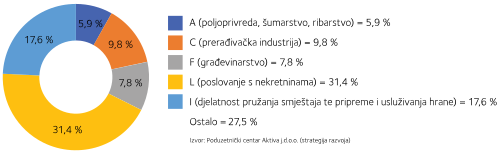
Entrepreneurs and craftsmen form the backbone of the development of the Municipality, and small companies dominate in terms of size and structure. There are 68 active business entities (craftsmen and entrepreneurs) in the Municipality, which makes Milna above average active and enterprising compared to other municipalities on the island. As for the number of employees by sector, in Milna, compared to the rest of the island, a large number of workers are employed in the primary sector, thanks to the successful operation of the agricultural cooperative. While only 19% of the population is employed in the secondary sector, the tertiary sector employs as many as 59% of the population, due to the high share of tourism and service activities.
Agriculture on the island today is a supplementary activity of individual family farms, which does not account for a large share in the total income or in the number of employees (6 %). A major obstacle to the development of agriculture is, in addition to the low level of application of modern methods in production, a large number of inaccessible and fragmented farms. In Milna, part of this problem is compensated by the work of an agricultural cooperative that brings together producers of traditional Mediterranean crops, such as grapevine, olive and citrus fruit cultivation, and fishing. In addition to Milnarane, the largest number of producers is from the settlement of Ložišća.
Fishing is a traditional economic activity for the inhabitants of Milna. Even today, the spirit of mariculture is preserved in Maslinova Bay, where bluefish, bream and tuna are farmed, which are processed at the Sardine Factory in Postira.
Over the past half century, tourism has improved the economic activities of Brač and Milna entrepreneurs, individuals and families.
Although tourism on Brač began to develop at the beginning of the last century, the real momentum came in the 1970s, when the planned construction of hotels, settlements, camps and infrastructure began and when the tourist offer expanded, which was no longer just sun, sea and swimming. Today, Brač as a tourist destination is known for its developed and diverse tourist offer (rural, cultural, recreational, nautical, wine and gastro tourism), while Milna directed its development towards nautical tourism, in which the greatest potential has been recognized, although other forms of tourist offer have not been neglected.
| Countries | 2023. | 2024. | 2025. | |||
|---|---|---|---|---|---|---|
| Arrivals | Overnight stays | Arrivals | Overnight stays | Arrivals | Overnight stays | |
| Croatia | 1882 | 13904 | 2229 | 16856 | ||
| Germany | 3647 | 31273 | 3367 | 29619 | ||
| Poland | 1061 | 8247 | 1243 | 9562 | ||
| UK | 5192 | 39936 | 4983 | 37797 | ||
| Slovenia | 1209 | 10589 | 1135 | 10100 | ||
| Czech Republic | 595 | 5102 | 545 | 4307 | ||
| Hungary | 0 | 0 | 546 | 3990 | ||
| France | 732 | 4172 | 694 | 4106 | ||
| Austria | 831 | 6052 | 731 | 5630 | ||
| Bosnia and Herzegovina | 0 | 0 | 0 | 0 | ||
| Sweden | 854 | 5518 | 898 | 6085 | ||
| Norway | 0 | 0 | 0 | 0 | ||
| Italy | 529 | 3551 | 0 | 0 | ||
| Netherlands | 0 | 0 | 0 | 0 | ||
| Finland | 0 | 0 | 0 | 0 | ||
| Total domestic | 1882 | 13904 | 2229 | 16856 | ||
| Total foreign | 19238 | 145603 | 19118 | 145730 | ||
| Overall | 21120 | 159507 | 21347 | 162586 | ||
Note: arrivals of weekenders and nautical tourists are not included.
Thanks to its favorable spatial position and naturally indented coastline, which hides safe and preserved bays on the western side of the island of Brač, Milna has become a safe and almost unavoidable port in the offer of Croatian nautical tourism, which has become a recognizable offer for sailors who are just discovering these areas. Nautical tourism is the fastest growing segment of the maritime industry, with great growth potential, and is a natural continuation of the development of Milna, which has never ceased to be a maritime town. Nautical tourism provides Milna with a higher level of development and an extension of the tourist season, greater employment, year-round income, etc.
Three marinas are open in Milna all year round, and due to the increased demand for berths, the plan is to expand the existing capacities and upgrade the port of Milna in the Racić area. The number of arrivals in Milna marinas is increasing every year, so in the record year 2019, more than 110,000 vessels entered Milna.
| Year | Income in euros |
|---|---|
| 2025. | |
| 2024. | *88.064,32 |
| 2023. | *49.576,49 |
*Income was transferred to the Municipality of Milna (30%) and TZ Milna (70%)

Croatia has a population of around 4.28 million and is rich in renewable energy sources, mainly wind, hydropower and solar energy. As part of the European Green Deal, the European Commission proposed measures in September 2020 with targets for 2030:
– at least 40 % greenhouse gas emission reductions
– at least 32 % share in renewable energy
– improving energy efficiency by at least 32.5 %.
A working group called the Island of Brač was established to develop an energy transition program, which includes all eight local government units, and Local Action Group (LAG) Brač, with the aim of developing an Action Plan for Sustainable Energy Development and Climate Change for the areas that include local government units (LGUs) of the island of Brač.
The vision of the stakeholders of the energy transition of the island of Brač is to transform Brač in a "green" direction, which includes: increasing energy efficiency, achieving energy independence of the island, regulating and improving public transport, and building a waste management center. All of this should be implemented in the five pillars of the energy transition towards clean energy:
1. electricity production
2. heating and cooling
3. transportation from/to the island
4. transportation on the island
5. other measures
It is in the interest of the island's stakeholders that the island of Brač becomes an energy-independent and clean island by 2030, offering its residents a life in a healthy environment, and tourists during the season the opportunity for a pleasant stay on a "green" island, with a variety of amenities and activities.
The Strategic Development Plan of the Municipality of Milna is currently being drafted. The measures that the Municipality intends to take to contribute to the energy efficiency and independence of the island are included in the following projects:
– modernization of the public lighting system – the project has been developed and applied to the Environmental Protection and Energy Efficiency Fund, and the Fund's share of 54 % is expected;
– construction of solar cells on local water reservoirs (pjoveri), total area 2.1 ha (1 MW).
In 2012, the municipality established the utility company "Meštralun doo, for utility services", which performs activities of public interest, such as: maintenance of public green areas, unclassified roads, cemeteries, public lighting, parking lots, maintenance and management of public facilities, and is also responsible for the supply of drinking water, drainage and wastewater treatment, disposal and disposal of municipal waste, boat rental and other activities specified in the Decision and acts of establishment.
Economic and social conditions strongly influenced the population movement on the island of Brač and in Milna.
By the end of the 18th century, the population of Brač was constantly growing, and Milna was one of the most economically developed places on the island, with the largest population. In 1900, Milna had 2,579 inhabitants (the area of today's municipality had as many as 4,760 inhabitants), while the island of Brač had around 24,000 inhabitants.
The first big wave of emigration was recorded at the turn of the century, when sailing ships were replaced by more powerful steamships and shipyards were closed. Part of the population that was connected to seafaring and shipbuilding leaves the island, and the rest are redirected to fishing and the cultivation of island cultures, especially vines. After the vine disease, phylloxera, ravaged the vineyards of Brac, the production and sale of wine declined, so many locals left the island and went to overseas countries, mostly to South America.
A new exodus of Brač residents began after World War I and lasted until the middle of the 20th century. Already in 1921, 3,243 inhabitants were recorded in the area of the present-day Municipality, and 19,339 on the island of Brač, which was a significant decrease compared to the previous census (from 1910), as many as 15,000 fewer inhabitants.
| Year | Milna | Bobovišće | Fire pit | Bobovišće n/m | Pothum | Island of Brac | Index |
|---|---|---|---|---|---|---|---|
| 1900 | 2.579 | 625 | 1.473 | 19 | 65 | 24.408 | - |
| 1910 | 2.293 | 433 | 1.219 | 14 | 83 | 22.696 | -7,0 |
| 1921 | 3243** | - | - | - | - | 19.339 | -14.8 |
Source: Entrepreneurial Center Aktiva jdoo, according to: Central Bureau of Statistics www.dzs.hr
*List by Municipality
In those approximately forty years (from 1910 to 1953), the population of Brač and Milna almost halved. Emigration continued until the 1990s, but slowed down.
| Year | Milna | Bobovišće | Fire pit | Bobovišće n/m | Pothum | Island of Brac | Index |
|---|---|---|---|---|---|---|---|
| 1931 | 1.645 | 244 | 775 | 18 | - | 17.331 | -10.4 |
| 1946 | 1.212 | 166 | 541 | 18 | 55 | 14.664 | -15.4 |
| 1953 | 1.231 | 137 | 497 | 14 | 59 | 14.721 | -0.4 |
| 1961 | 1.221 | 102* | 437 | 102* | - | 14.227 | -3.4 |
| 1971 | 1.056 | 75* | 285 | 75* | - | 12.893 | -9.4 |
| 1981 | 860 | 52* | 190 | 52* | - | 12.715 | -1.4 |
| 1991 | 875 | 62* | 181 | 62* | - | 13.824 | 8.7 |
Source: Entrepreneurial Center Aktiva jdoo, according to: Central Bureau of Statistics www.dzs.hr
*Total Bobovišće and Bobovišće n/m
Only in recent years have departures from the islands become less frequent. Tourism has begun to develop rapidly (promising the islanders a better standard of living, better and faster connections to the mainland, greater investment in infrastructure construction). Brač and Milna have become better places to live, where life's desires and ambitions can be realized.
| Year | Milna | Bobovišće | Fire pit | Bobovišće n/m | Pothum | Island of Brac | Index |
|---|---|---|---|---|---|---|---|
| 2001 | 862 | 171* | 167 | 171* | - | 14.031 | 1.5 |
| 2011 | 830 | 65* | 139 | 65* | - | 13.956 | -0.5 |
Source: Entrepreneurial Center Aktiva jdoo, according to: Central Bureau of Statistics www.dzs.hr
*Total Bobovišće and Bobovišće n/m
It is difficult to predict whether and when Milna will experience its demographic peak from the end of the 18th century, but it is encouraging that the negative trend in population growth on the island has been halted.
The population density in Milna is 34 inhabitants per square kilometer, which is equal to the average for the island of Brač, while the area of the Municipality is less densely populated (29 inhabitants per square kilometer).
There are slightly more women than men living in the Municipality, but there are more men in the working age group up to 64 years of age.
The average age of the municipality's residents is 48.5 years, and the proportion of women in the older population is higher.
| Sex | Total | 0-14 years. | 17-19 years old. | 15-64 years old (working age) | 60-75 years old. | 75 and over. | Average age |
|---|---|---|---|---|---|---|---|
| Men | 440 | 96 | 175 | 355 | 316 | 56 | 46,8 |
| Women | 484 | 73 | 171 | 273 | 358 | 77 | 50,3 |
| Total | 1034 | 169 | 346 | 628 | 674 | 133 | 48,5 |
The people of Milna have always invested in education, and sometimes even today. The first school in Milna officially began operating in 1848, as a two-grade elementary school in the private house of the Buzolić family, which in 1882 moved to a neighboring building, owned by the Sfarčić family, and classes were held there until 1901. At that time, classes at the school were held in Italian and Croatian, and male and female children attended school in separate classes - a two-grade class for boys and a single-grade class for girls. It was not until the school year 1934/1935, in a newly built building, that the two schools were merged into one, six-grade elementary school that bore the name of the Crown Prince Peter II. In 1965/1966. It was decided that there would be one primary school in Milna in the Municipality, which would have the status of an independent primary school, and that children from other settlements that gravitate towards Milna would also attend that school. In 1977, the school building was renovated and equipped with modern equipment, so that children could study in almost ideal conditions, in specialized classrooms and only in the morning shift. It is also the only school on Brač that has its own school hall next to the school playground, an equipped school library, a dining room and a kitchen for preparing hot meals. In 1981, the school won the Republic Award for aesthetic decoration, maintenance of school premises and environmental protection. In the 1992/1993 school year, its old name was returned - Milna Primary School. Many workshops and extracurricular activities are also organized at the school, and its employees also initiate many cultural events.
In addition to the Municipality co-financing part of the transportation costs to school for "traveling students" and part of the transportation costs for extracurricular activities held outside Milna, all primary school students receive free textbooks and workbooks throughout their eight-year education.
The kindergarten in Milna began operating in 1961. Children who have reached the age of three are enrolled in the kindergarten to participate in the preschool educational program.
To enable every child to attend kindergarten, the Municipality has prepared a package of benefits for parents:
– The municipality co-finances the costs of living for every second child in the family with 50 %.
– for families with multiple children, accommodation for every third and subsequent child is free.
The plan is to adapt the building and add a floor to it, in order to provide and arrange space for nursery-age children.
There is no high school or academy in Milna, so children in higher grades most often continue their education in Supetar or Split, with which Milna is very well connected by transport. In order to encourage children to continue their education and achieve good results, the Municipality awards scholarships to high school students and university students every year in the amount of 500 kuna per month, with co-financing of transportation costs.
In order to relieve the financial burden on young parents and families with multiple children, the Municipality has adopted a program of measures and financial support.
| Newborn child | One-time | Monthly until the child reaches the age of three | Total |
|---|---|---|---|
| First | 670,00 | 70,00 | 3.190,00 |
| Else | 930,00 | 70,00 | 3.450,00 |
| Third | 1.350,00 | 80,00 | 4.230,00 |
| Fourth and every subsequent one | 2.000,00 | 100,00 | 5.600,00 |
| Compensation | Per year |
|---|---|
| One-time support for artificial insemination procedure | 663,61 |
Care for socially vulnerable groups is reflected in care for the elderly and infirm, as well as the socially vulnerable. Financial assistance is intended for family members who have a sick household member, and there are also one-off grants for residents of lower financial status.
• All households whose members are over 65 years old are exempt from paying utility fees.
• Living expenses are co-financed monthly for beneficiaries of the minimum benefit from the Social Welfare Center.
• All pensioners are paid a one-time financial assistance for Christmas, depending on the amount of their regular pension (those with a pension of less than 1,500 kn are paid 300 kn, and those with a pension of more than 1,500 kn are paid 200 kn in a one-time payment).
• As part of the housing care program, the facades of houses are arranged in the amount of up to HRK 30,000, and the living space is arranged or adapted.
How much the residents of the Municipality of Milna value their own initiative and civil society is best seen in the fact that there are many associations operating in the Municipality, whose activities encompass a wide range of interests of modern society: from culture and art, sports, sustainable development to social activities, preservation of cultural heritage, promotion of a healthy lifestyle, etc.
Every year, the budget plans funds for donations to associations and non-profit organizations to support their work. The funds are allocated for projects based on announced tenders.
| Association | Contact / person authorized to represent |
|---|---|
| Milna Volunteer Fire Department | |
| Gea Viva - association for co-creating synergistic life on Brač | |
| Association for the protection of antiquities, culture, old customs and ecology Milna-Baterija-Pothuma | |
| Milnarani Music Association | |
| Cervantes Amateur Theatre Milna | |
| Radio Club Milna 9A1CDO | |
| Croatian Public Education, Ložišće | |
| Uzmah, Lozisce | |
| Osibova uvala Association | |
| Spalatos Cultural and Historical Association | |
| Milna Mother Society | |
| Fortuna Motorcycle Club | |
| Šarag Sports Club | |
| The Pulling Mrduje Association | |
| Crvana Mountaineering Association | |
| Mrduja Milna Marine Sports Fishing Association | |
| Association for Sports Recreation and Culture Bobovišće na Moru | |
| Milna Sports Club | |
| Paintball airsoft club Mrduja | |
| Waves of Brač | |
| Osibova Youth Club | |
| Youth Association Put Milne |
| User | Amount in kuna |
|---|---|
| Croatian Mountain Rescue Service | 18.00,00 |
| Brač Hunting Association | 9.000,00 |
| Island Brac, Solta | 8.000,00 |
| DDDK | 5.000,00 |
| Milna Sports Club | 15.000,00 |
| Crvana Balloonists Association, Milna | 37.000,00 |
| KŠRM Mrduja | 30.000,00 |
| Bobovišća na Moru Association | 10.000,00 |
| Association Brački budoljci | 10.000,00 |
| Milna Mother Society | 37.000,00 |
| Croatian Public Education Ložišće | 21.000,00 |
| Karate club Dojo, Brač | 10.000,00 |
| Fortuna Motorcycle Club | 40.000,00 |
| Cervantes Amateur Theater | 24.000,00 |
| Other sports associations | 10.000,00 |
| Cookie | Duration | Description |
|---|---|---|
| cookielawinfo-checkbox-advertisement | 1 year | This cookie is set by the "GDPR Cookie Consent" plugin to record user consent for cookies in the "Advertising" category. |
| cookielawinfo-checkbox-analytics | 1 year | This cookie is set by the "GDPR Cookie Consent" plugin to record user consent for cookies in the "Analytics" category. |
| cookielawinfo-checkbox-necessary | 1 year | This cookie is set by the "GDPR Cookie Consent" plugin to record user consent for cookies in the "Necessary" category. |
| cookielawinfo-checkbox-performance | 1 year | This cookie is set by the "GDPR Cookie Consent" plugin to record user consent for cookies in the "Performance" category. |
| PH_HPXY_CHECK | session | This cookie stores information about the user's current session. |
| Cookie | Duration | Description |
|---|---|---|
| cookielawinfo-checkbox-functional | 1 year | This cookie is set by the "GDPR Cookie Consent" plugin to record user consent for cookies in the "Functional" category. |
| cookielawinfo-checkbox-others | 1 year | No description |